
OurTop10 Research · October 2026 · Survey of 1,018 Australians
Negative gearing and capital gains tax (CGT) changes could become a Federal election flashpoint. New OurTop10 research shows two in three Australians (66%) would vote for a party promising to reverse them.
Two in three would back a reversal
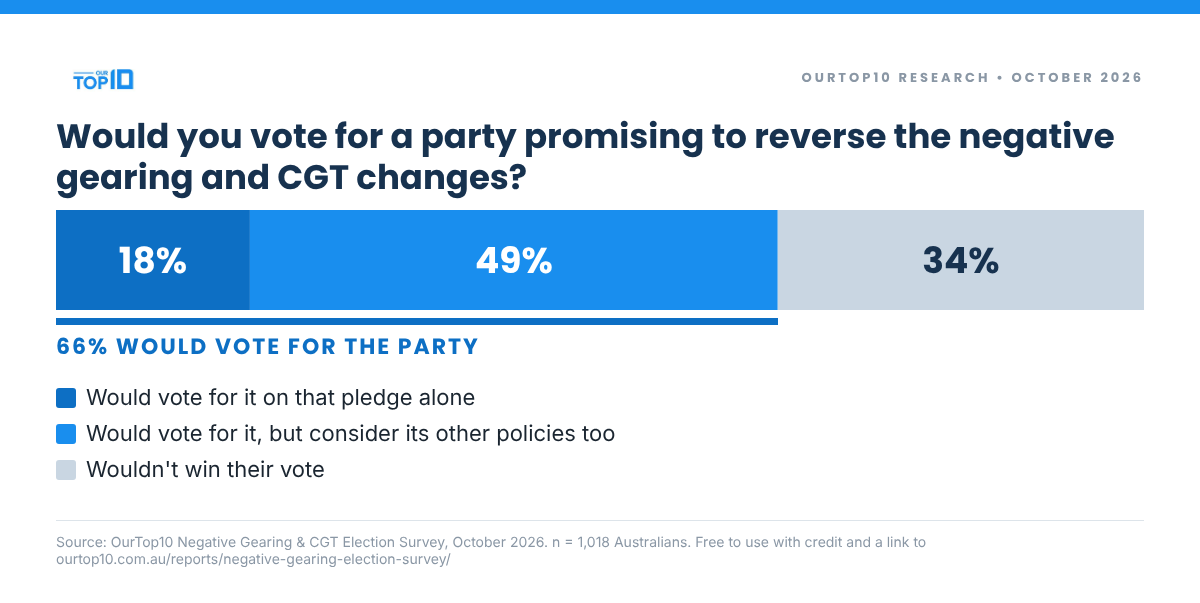
The nationally representative survey of more than 1,000 Australians found 66% would vote for a party making that promise, including 18% who would back it on that pledge alone, regardless of its other policies. A further 49% said they would back it but would also consider its broader policies. Around a third of Australians (34%) said the promise wouldn’t win their vote.
The findings come as both the Coalition and One Nation have pledged to restore the 50% CGT discount and negative gearing, though One Nation would cap negative gearing at two properties per investor. The next Federal election is due by May 2028.
Younger Australians more likely to make tax reversal their deciding issue
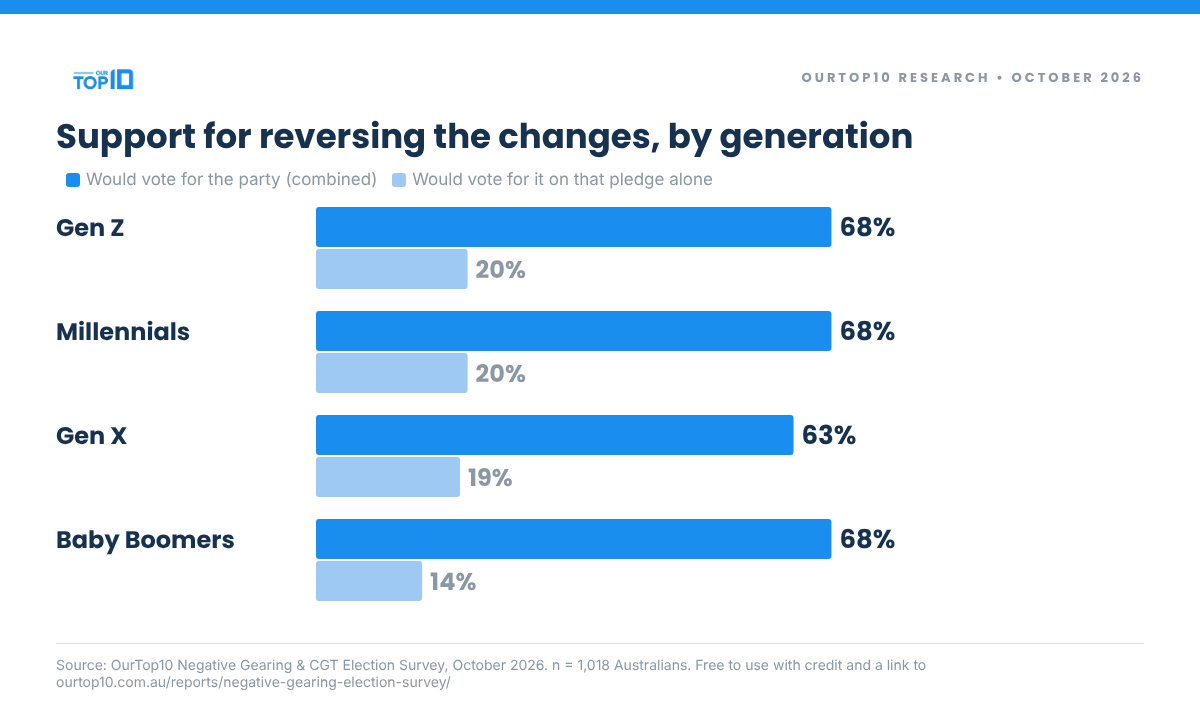
Results were broadly consistent across generations. Gen Z, Millennials and Baby Boomers were equally likely to back a party promising to reverse changes to negative gearing and the CGT discount, with combined support of 68% across each generation, compared with 63% of Gen X.
But younger Australians were more likely to put that promise ahead of all other policies: 20% of Gen Z and Millennials would back the party on that pledge alone, compared with 19% of Gen X and 14% of Baby Boomers.
Homeowners lead support for reversing property tax changes
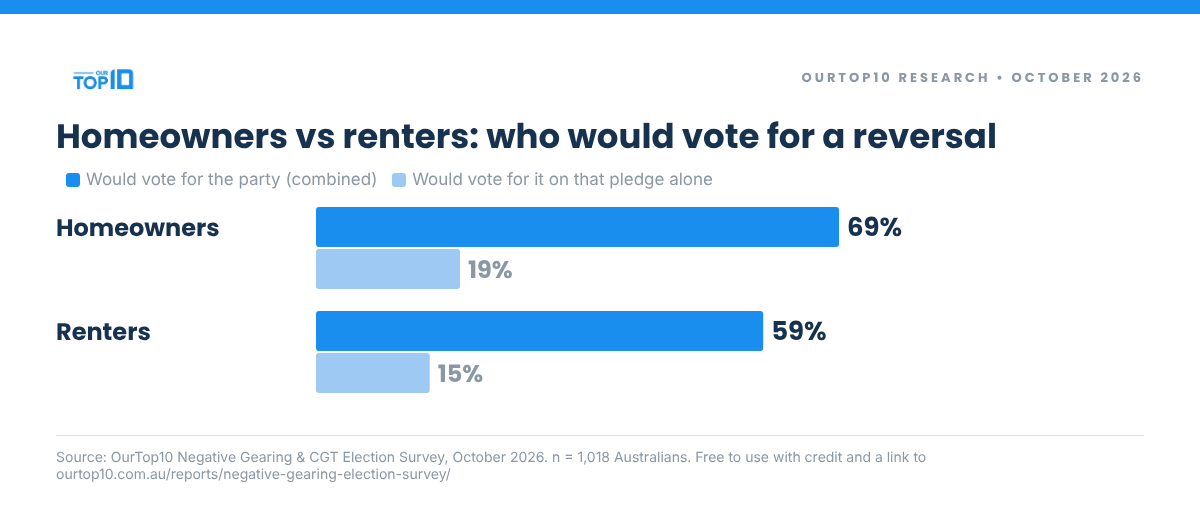
Homeowners were more likely than renters to back a party promising to reverse the changes, with combined support of 69% compared with 59%. Nearly one in five homeowners (19%) would vote for it regardless of its other policies, compared with 15% of renters.
What OurTop10 says

Head of Research at OurTop10, Mansour Soltani, says a pledge to reverse property tax changes could be just as appealing to younger voters as older generations.
These reforms were sold as the fix to ‘intergenerational inequality’, but they’ve clearly curdled with younger voters. They’re just as likely as older Australians to vote for a party that would scrap them, and more willing to put that promise ahead of everything else. That should ring alarm bells: the generation these reforms were supposed to help could help vote them out.
Younger Australians were promised a leg-up, but some feel they’ve been sold a dud. Four rate hikes this year have slashed their borrowing power, so even with prices falling, many still can’t get into the market. And those who stretched to buy with a 5% deposit are now watching their home’s value slide, with some already falling into negative equity. Meanwhile, the wealth-building strategies their parents and grandparents used are being taken off the table. To them, that looks less like levelling the playing field and more like pulling up the ladder.
What brokers are seeing

Since Budget night, a lot of the investors I speak with have hit pause. Some are hanging on to properties they would otherwise have sold, and others will only look at new builds because those keep the old tax treatment. My advice is not to bank on a reversal. The election could be more than a year away, and nobody should buy a property that only stacks up if the law changes back.
Ryan Rodriguez, Director, bspoke finance
What the 2026 reforms do
- Announced in the May 2026 Federal Budget and passed by Parliament in June 2026.
- From 1 July 2027, the 50% CGT discount is replaced by indexation of the cost base plus a 30% minimum tax on capital gains. Gains made before that date keep the 50% discount.
- Established residential properties bought after 7.30pm on Budget night (12 May 2026) lose negative gearing from 1 July 2027: rental losses can only be offset against rental income or property gains, not wages. New builds, and properties bought before that time, are exempt.
- The Coalition and One Nation have both pledged to restore the 50% CGT discount and negative gearing. One Nation would cap negative gearing at two properties per investor.
Methodology
OurTop10 commissioned the survey from PureProfile, with a nationally representative sample of 1,018 Australians aged 18 and over, stratified by gender, age and location. Responses were anonymous. Figures may not add to 100% due to rounding. “Combined support” adds those who would back the party on that pledge alone to those who would back it but also consider its broader policies. Each figure is rounded separately, so 18% and 49% can sum to 67% while the combined figure is 66%.
Using this research
This report and its charts are free to use. If you use this information, please credit OurTop10 and link to https://ourtop10.com.au/reports/negative-gearing-election-survey/
Related OurTop10 research and tools
- Mortgage Stress Report: which postcodes have the most households under mortgage pressure, updated every quarter.
- Default Loan Report: where households are most at risk of falling behind on repayments.
- OurTop10 Rate Prediction Index: what economists and the market expect from the RBA at its next meeting.
- The AI Fraud Report: how many Australians have used AI to create or alter home loan documents.
- Negative gearing calculator and capital gains tax calculator: see what the 2026 changes mean for your own property.
Downloads
Free to download. If you use it, please credit OurTop10 and link to this page.
For journalists: charts
Media contact
Mansour Soltani, Head of Research, OurTop10 · 0405 500 981 · [email protected]