
What is a rental ledger?
A rental ledger is a running record of every rent payment on a tenancy: the date each payment was due, how much it was, what was actually paid, and the balance left owing. Your agent keeps one. This page gives you your own — you can type in what you actually paid, see at a glance how far ahead or behind you are, handle a rent increase part-way through, and download it as a spreadsheet or print it.
Monthly rent is not the weekly rent times four. Enter your weekly rent and we will put the correct monthly amount in the box above.
If your rent went up part-way through, put the new amount and the date it started. Every payment from that date on uses the new figure.
Download the blank template
Prefer to fill it in by hand, or keep it in a spreadsheet? Both versions carry the same six things a bank, a tribunal or a new agent looks for.
- Rental ledger template (Excel) — 60 rows, the balance column works itself out, and a second sheet setting out what a ledger has to show and how to ask your agent for the official copy.
- Rental ledger template (PDF) — one page, 26 rows, print it and fill it in by hand.
Fill in what you actually paid
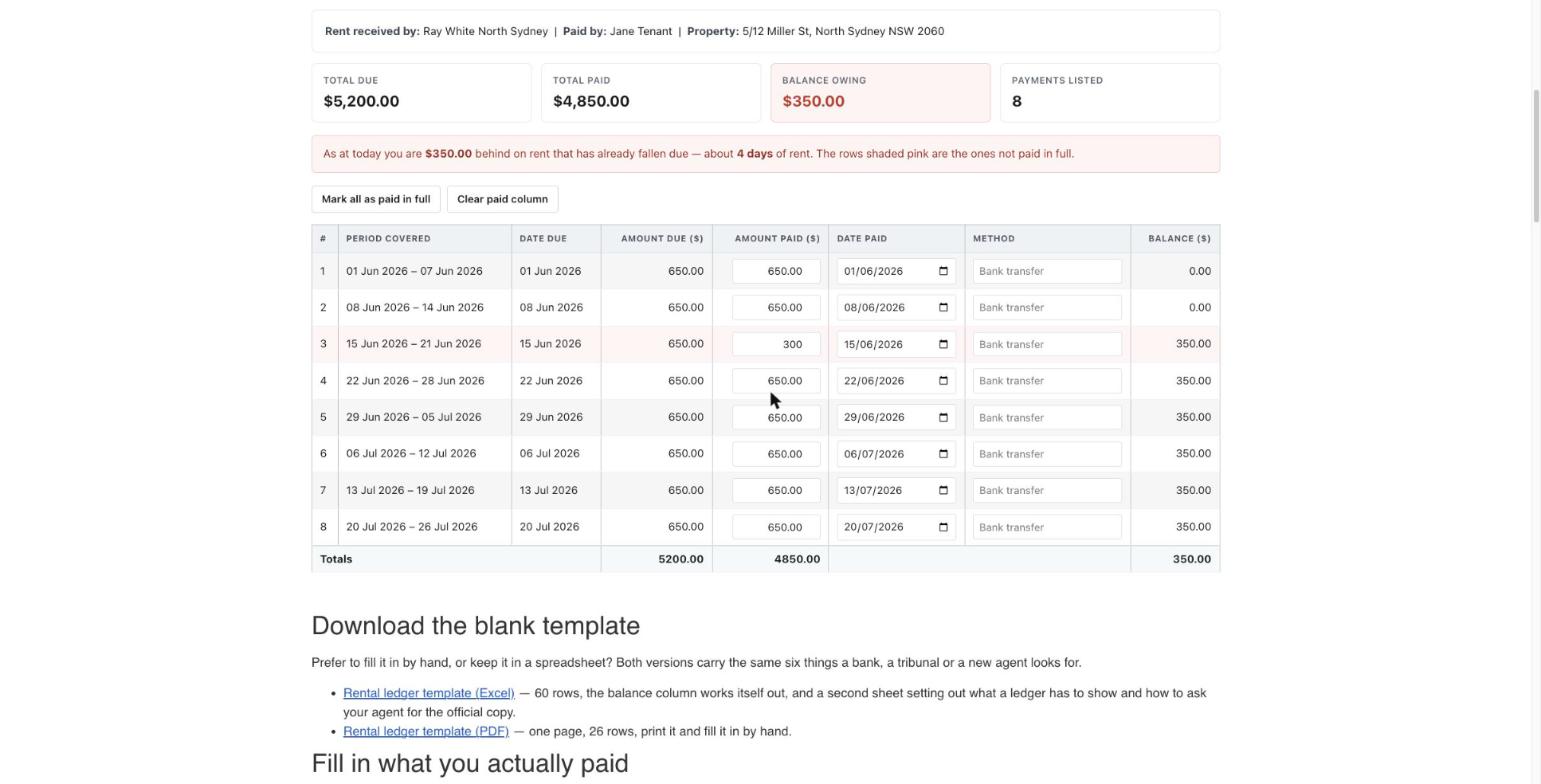
Once you press Generate ledger, the Amount paid, Date paid and Method boxes in the table can all be typed into. That is the part that matters. A ledger where every payment is assumed to be on time proves nothing — the reason anyone builds one is to show a missed week, a short payment, or a fortnight paid twice.
Use Mark all as paid in full to fill the column in one go, then change only the rows that were different. The balance column and the running total at the top update as you type, and the summary says in plain words if you are ahead, square or behind as at today.
What a rent ledger has to show
Whatever state you rent in, a ledger that a bank, a tribunal or a new agent will accept shows the same six things for every payment:
- Who received the rent — the agent or the owner
- Who paid it
- The address of the rental property
- The date the payment was made
- The amount paid
- The period that payment covers
Those six are common to the rent-record rules in every state and territory, and the generator above puts all six on the page and in the downloaded file. A ledger that is missing the period covered is the one that causes arguments, because two people can agree on the dollars and still disagree about which weeks are paid up.
What does a rental ledger look like in Australia?
One row per rent payment, in date order, showing the period each payment covers, the amount due, the amount paid and a running balance. Australian agents produce theirs out of trust account software, so it also names the agency, the tenant and the property address at the top. That is what the generator on this page produces, and what the Excel and PDF templates set out.
The rules where you live
Every state and territory sets its own rules on what the agent or owner has to keep, what they have to give you, and how quickly. Open your own below.
New South Wales rental ledger rules
Your landlord or agent has to keep a record or ledger of rent received, showing who received it, who paid it, the property address, the rental period, the payment date and the amount.
If you ask for a copy in writing, they have 7 days to give you one.
Where rent is paid in person and not by cheque, a receipt has to be handed over at the time you pay.
NSW does not name a set number of years the record has to be kept, so ask early rather than years later.
Victorian rent record rules
A rental provider has to keep rent records for at least 12 months.
A receipt has to be given immediately if you pay in person, or within five business days of you asking.
The receipt has to carry the rental provider’s name and signature, the address, the date, the period the payment covers, the amount, and a plain statement that it is a rent receipt.
There are fines for not following these rules.
Queensland rental ledger rules
The property manager or owner has to keep an accurate rent ledger and hold onto it for one year after the tenancy ends.
You can ask for a copy at any time and it has to be provided within 7 days.
If you pay in cash, or pay by cheque and ask for one, a receipt has to be given — not giving one is an offence.
Western Australia rent record rules
The landlord has to keep a rent record showing that the payment is rent, the date it was received, who paid it, the amount, the period it covers and the address.
A receipt has to be given within 3 days of the rent being received — but not if the rent goes straight into the landlord’s nominated bank account.
Fines of up to $5,000 apply for failing to keep the records, and the same again for a knowingly false entry.
WA does not set a retention period, and does not give you a stated deadline for getting a copy. Ask in writing anyway, and keep your own.
South Australia rent record rules
The landlord has to keep a rent record showing the date received, who paid, the amount, the address, the period covered and what the payment was for. Arrears at the date of payment should be shown clearly.
A receipt has to be given within 48 hours — unless rent goes into a nominated bank account and written records are kept.
You can ask for a statement of rent received for a stated period, and it has to be given within 7 days of you asking.
Penalties run to $20,000 for record failures and $25,000 for receipt or statement failures.
Tasmania rent receipt rules
If you pay by cash or cheque, the owner has to give you a receipt showing the date received, your name, the address, the amount and the period it covers.
Tasmania is the odd one out: there is no general legal duty on an owner to keep a rent ledger, no retention period, and no set deadline for handing you a copy. Consumer Building and Occupational Services offers a ledger template as good practice only. That makes keeping your own record more important here, not less.
ACT rent record rules
The lessor has to keep records of rent payments and hold them for at least 12 months after the tenancy ends.
Rent paid in person has to be receipted at the time. Otherwise the receipt has to be given or posted within one week.
If details such as the date, the period or the address are left off the receipt, the lessor has to supply them within four weeks of you asking.
No receipt is needed where rent is paid into the nominated account.
There is no separate stated right to demand a copy of the whole rent record.
Northern Territory rent record rules
The landlord has to keep a written or electronic record of every rent instalment showing the amount, the date received, the period covered and the address.
You may ask to examine the rent record and the landlord has to let you — though no deadline is stated.
Cash gets a receipt immediately; cash paid by someone on your behalf by the end of the next business day; a cheque on request within 3 business days. Nothing is required for a direct deposit.
Penalties apply for record or receipt failures, and heavier ones for falsifying a record.
Sources: NSW Government — rent records, NSW Government — rent receipts, Consumer Affairs Victoria, Residential Tenancies Authority Queensland, Consumer Protection WA, Consumer and Business Services SA, CBOS Tasmania, ACT standard residential tenancy terms, NT Government — paying rent. Checked 9 September 2026.
Tenant ledger, rental ledger, tenancy ledger — the same document
Three names, one piece of paper. Agents, banks and tribunals use them interchangeably, and some agencies call it a rent statement instead. If a lender asks for a tenant ledger and your agent sends something headed “rental ledger”, you have the right document.
Two phrases do mean something specific. A current tenant ledger is the one covering the tenancy you are in now, which is what a lender or a new agent almost always wants. A previous tenant ledger covers a tenancy you have already left — worth asking for before you hand the keys back, because agents are much slower to dig one out months later.
If you are the landlord or the property manager
The ledger is not only the tenant’s document. If you own the property or manage it, it is the record that does three jobs.
It keeps rent collection straight. Who has paid, who has not, when the money landed and how it came in. That matters most when you are running more than one property and the weeks start blurring together.
It carries your tax position. The ledger is the detailed record of rent income for an investment property — amounts, dates and receipts — which is what supports what you report and what you claim. The Australian Taxation Office expects records like these to be kept for at least five years. It also makes working out the yield on the property a matter of reading a column rather than reconstructing a year.
It is your evidence. If a rent dispute reaches a tribunal, a ledger kept properly from the first week beats a reconstruction assembled after the argument starts.

Why a lender asks for one
If you are renting and applying for a home loan, the ledger does two jobs at once.
The first is conduct. A lender wants to see that you have paid a housing cost on time, every time, for at least six months. A clean ledger is the cheapest proof of that you will ever produce, and it is stronger than a bank statement because it shows what was due as well as what was paid.
The second is deposit. Some lenders will count a documented rental history in place of the usual five per cent saved over three months, which is the rule most first home buyers get caught by. Not every lender does it and the ones that do want the ledger from the agent, not a hand-written list. We wrote about how that works in rent as genuine savings.

The ledger you build here is for your own records and for checking the agent’s version against your bank statements. When a lender asks for one, get the official copy from the agent using the request rights above.
Watch the monthly figure
The most common mistake in a hand-built ledger is monthly rent. Monthly rent is not the weekly rent times four. There are 52 weeks in a year and 12 months, so the monthly amount is the weekly rent times 52, divided by 12.
On $650 a week that is $2,816.67 a month, not $2,600. Over a year the difference is $2,600 — about a month’s rent. Choose Month in the generator above and it will work the figure out from your weekly rent for you.
Questions people ask
How do I create a rental ledger?
Put in the tenant, the agent or owner, the address, the rent and the date the first payment was due, then press Generate ledger and type what you actually paid into each row. If you would rather start from a blank sheet, download the Excel or PDF template above.
Where can I get a rental ledger from?
From your agent or landlord, who has to keep one. In NSW, Queensland and South Australia you ask in writing and they have seven days to hand it over. Victoria and the ACT keep records for 12 months. Western Australia, Tasmania and the Northern Territory set no deadline, so ask early. The one you build here is for checking theirs, not for replacing it.
What is the best format for a rental ledger?
A spreadsheet, because the balance column keeps itself right and nobody can argue with the arithmetic. Print it or save it as a PDF when you send it to someone. A photo of a handwritten page is the one format a lender will usually send back.
Can a ledger help in a rent dispute?
It is usually the only thing that settles one. A ledger kept week by week shows what was due and what was paid, in order, with dates. Where a tenant and an agent disagree, the argument is almost always about which week a payment was applied to, and two ledgers side by side find that row in a minute.
Can I use a rental ledger for tax?
If you own the property, yes — it is the record of rent income behind what you report and claim, and the Australian Taxation Office expects records like it to be kept for at least five years. If you are the tenant, rent on your own home is not deductible, so the ledger is for proving conduct to a lender rather than for your return. Anything specific to your situation is a question for your accountant.
What if there is an error in the ledger?
Put it in writing to the agent, name the row and the date, and attach the bank line that proves it. Do not wait for the end of the tenancy. In NSW, Queensland and South Australia a written request also starts the seven-day clock for a fresh copy, so ask for the corrected ledger in the same message.
Digital or paper?
Digital, and keep the file rather than a photo of a screen. A spreadsheet keeps the balance column right on its own, and it is the format an agent, a lender or a tribunal can open without squinting. Print it when someone needs it on paper.
How do I record a week I missed?
Leave the Amount paid box for that row empty, or type the part you did pay. The balance column carries the shortfall forward to every row after it, and the summary at the top tells you how far behind that puts you in dollars and in days of rent. When you catch it up later, type the larger payment into the row where the money actually landed rather than backdating it.
Can I get a rental ledger from a private landlord?
Yes. A private landlord has the same duty to keep a rent record as an agent does, and in NSW, Queensland and South Australia the same seven-day rule applies when you ask in writing. What you get back is usually less formal than an agency printout, so keep your own copy from this page alongside it and expect a lender to also want your bank statements covering the same weeks.
Can I make my own ledger instead of asking the agent?
For your own records, yes, and it is worth doing so you can check the agent’s copy. For a loan application or a tribunal hearing, no. Those need the copy the agent produces, because it comes from their trust account records.
How far back can I ask for?
Queensland keeps the record for a year after the tenancy ends, Victoria and the ACT for 12 months. NSW, WA, Tasmania and the NT do not name a period at all. Ask early rather than years later — and keep your own copy as you go, which is the only version nobody can lose.
What if the agent’s ledger and my bank statements disagree?
Put the two side by side and find the first row where they part company. Nine times out of ten it is a payment applied to the wrong week rather than money that went missing. Ask the agent in writing for the ledger covering that period, which starts the 7-day clock in NSW, Queensland and South Australia.
Does the ledger show a rent increase?
It should — the amount due changes from the date the increase takes effect. Put the new amount and its start date in the rent increase boxes above and the table splits itself, with the changed rows shaded so you can see where it happened.
Is anything I type here saved?
No. The generator runs inside your own browser. Nothing is sent to us and nothing is stored. Close the page and it is gone, so download the file if you want to keep it.
Getting a loan together while you rent?
Which lender will count your rental history, and how much of it they want, differs at every bank. A broker who does this daily will know before you apply.